You're at your laptop. A slide deck needs finishing. An email lands. Your phone lights up on the desk. Somewhere a headline about something happening ten thousand kilometres away pushes itself onto your lock screen, and for a second you're not in the deck anymore, you're reading it.
Then you go back to the slide. Except part of you doesn't, not really.
The number that stopped me
The German health insurer BKK puts the average yearly cost of employee absence at around 3,600 euros per person. Only 30 percent of that is people actually being sick: home, in bed, off the clock. The other 70 percent is something with a real name: presenteeism. Physically at the desk. Mentally somewhere else.
A director at Accenture put it plainly: understanding and managing your own attention is now the single most important skill for business success.
I found this out the slow way, from inside a job that ran on speed. A few years ago I was Global Marketing Manager at Siemens, in an environment shaped by pressure and pace. I started practising mindfulness privately, mostly to survive the pace. What actually happened was I got faster at the same work, made fewer mistakes, and stopped mentally checking out in meetings. So I brought it to work: a weekly mindful lunch break, thirty people invited by email. Eighteen months later, with zero further promotion, that list had grown to 900 people. (The full story of how that turned into Zen & Go is here, if you want it.)
Two things are competing for your attention right now
And only one of them is your phone.
The first is external. In the literature this gets shortened to P.A.I.D. reality: Pressure, Always-on, Information overload, Distractions. Notifications, Teams messages, the meeting after this one, a headline from the other side of the world landing on your lock screen mid-task.
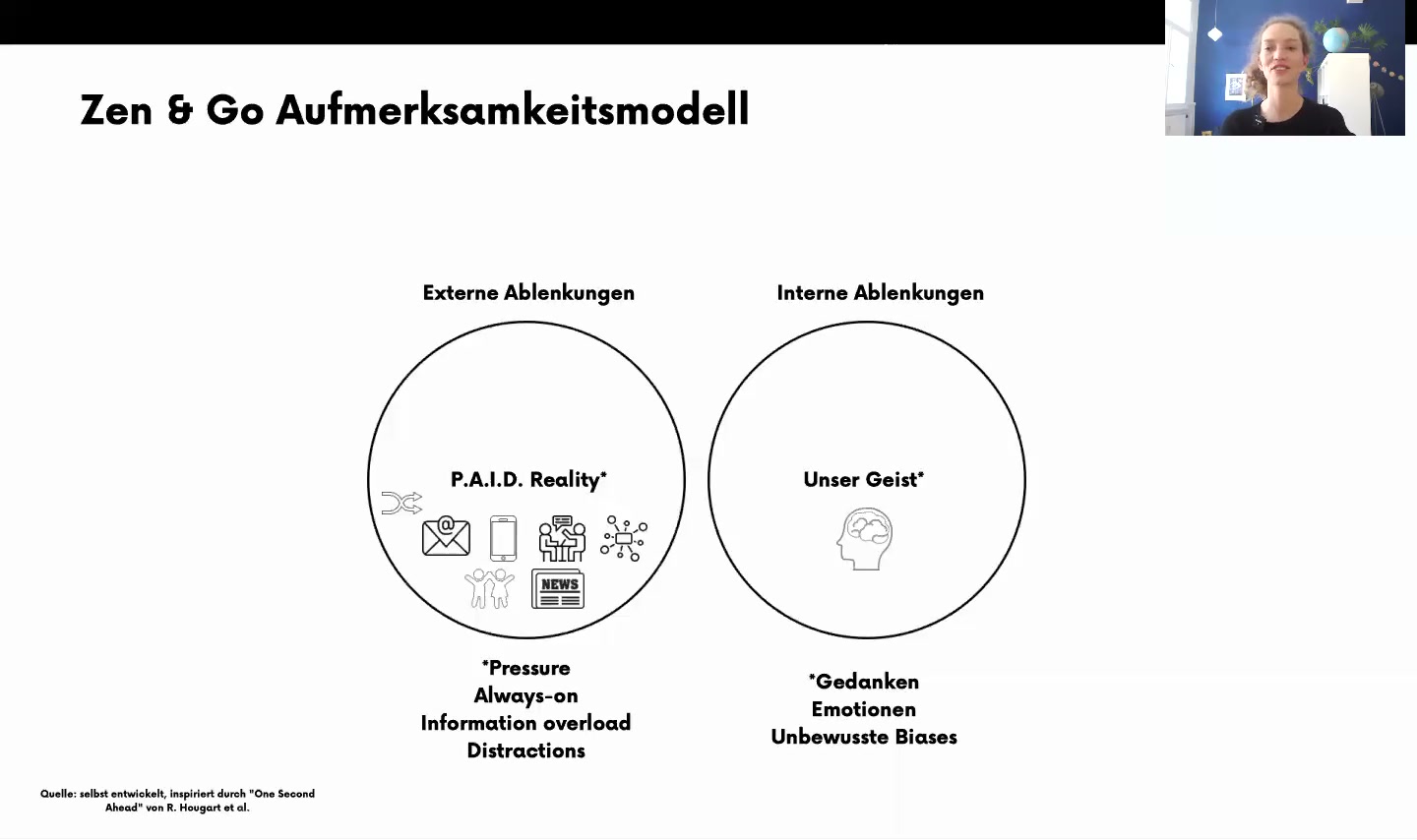
The second is internal, and it gets far less airtime in most workplaces. Research puts the average adult mind wandering roughly 47 percent of the day. Not distracted by something specific. Just gone, somewhere else, while the body keeps typing.
Try it for one minute.
Pick one thing in front of you right now: an object, a word, a name. Set a timer for sixty seconds and give it your full attention, nothing else.
Most people find this uncomfortable well before the minute is up. That's not a failure. That's just what an untrained mind does.
What this is actually training
Skip the image of ten years in a monastery. The high performers who build this deliberately, in elite sport, in the military, at companies like SAP and Bosch, are training three specific things: presence (attention actually in the room, not off replaying yesterday), awareness (catching the autopilot before it reaches for the phone, since we run on autopilot roughly 95 percent of the day), and an open mind that meets a new idea or a new person without immediately filing them into an old box.
What actually changes
None of this is abstract anymore. Brain scans of people who meditate a few minutes a day for eight weeks show measurable change: more grey matter in the prefrontal cortex, the part of the brain responsible for focus and decision-making. The amygdala, the brain's stress alarm, shrinks.
Aetna, a US insurer with roughly 50,000 employees, measured the business case directly: after mindfulness training, about 2,000 dollars less in sick-day costs and 3,000 dollars more in productivity, per employee, per year.
My own eight-week programme, run with a mixed group of leaders and team members, tracked a similar shift over two months: concentration up 16 percent, creativity up close to 20 percent, perceived stress down close to 40 percent.
One more, for before your next call.
Feet flat on the floor. Sit slightly away from the back of your chair, so your spine can lengthen. Hands resting in your lap. Eyes closed, or a soft focus point just in front of you.
For one minute, notice your breath. Not controlling it, just feeling where you notice it in your body.
Sixty seconds. That's the whole practice.
The reins, not the storm
An untrained mind is a horse with loose reins, running wherever it wants, and you're just along for the ride. Training your attention doesn't stop the world from being stressful. It hands you the reins back. You still feel what's happening around you. You just get to decide where you go next.
With whatever presence I've got left after writing this,


P.S. If you want to bring this into your team as a real eight-week programme, not a one-off workshop, write to contact@zen-and-go.de.